


$10K Off the Price vs. $10K in Closing Costs

The same $10,000 can show up in your offer two different ways, and they do very different things. One helps your future self. The other helps you on closing day. Here is how to tell which one you actually need.
Imagine this. You find a house you love. You're ready to write an offer. But then your lender and I start talking strategy, and you hear a sentence that sounds a little scary:
"We could ask for ten thousand off the price, or ten thousand in seller-paid closing costs."
Both options sound like $10,000 to you, and if you're like most people, you nod your head, pretend you understand, and then go home and think, "I really hope I don't make a $10,000 mistake."
That worry shouldn't keep you up at night. Below, I'll walk through this choice in simple terms, the way I explain it to buyers in Fargo, Moorhead, and West Fargo.
About the numbers on this page: every figure here is an example, not a rate quote or a promise. Interest rates, closing costs, and loan guidelines change often. Before we structure an offer, have your lender run your exact numbers for the specific house you're considering.
What's the difference between $10,000 off the price and $10,000 in closing costs?
Taking $10,000 off the price shrinks your loan, which lowers your monthly payment slightly and saves you a lot of interest over thirty years. Getting $10,000 in seller-paid closing costs leaves the loan the same but cuts the cash you hand over at closing. The first helps your future self. The second helps you right now.
There are two main ways that the same $10,000 can show up in your offer:
- $10,000 off the purchase price
- $10,000 the seller pays toward your closing costs
On paper those look almost identical. In real life they behave very differently. One speaks to your future self. The other speaks to your right-now self. You need to know which version of you is louder at this stage of life.
What happens if I take $10,000 off the purchase price?
Your loan amount drops, so your monthly payment falls modestly and your total interest falls substantially. In one common example, $10,000 off a $325,000 purchase lowered the payment by roughly $60 a month and cut about $12,000 of interest over a thirty-year loan. What it does not do is reduce the cash you need at the closing table.
Imagine you're buying a home for around $325,000, a typical amount in our area for a financed buyer. If you negotiate the price down to $315,000, it usually means:
- Your loan amount is smaller
- Your monthly payment is a little lower
- Over the life of the loan, you pay less total interest
Your numbers will differ, but that gives you a sense of the scale. The catch is simple: you still have to bring your own closing costs and prepaids to the table. The price is lower, but the cash you need up front doesn't change much.
This option tends to fit you if you:
- plan to stay put for a while
- have the cash for closing and still keep a cushion in savings
- care a lot about paying less interest over the long run
What happens if the seller pays $10,000 toward my closing costs?
The price stays the same, so your loan and monthly payment stay roughly the same, but the cash you bring to closing drops sharply. In a typical local example, a buyer expecting to bring around $25,000 might bring closer to $15,000 instead. How much of the $10,000 you actually capture depends on your costs and your loan program's limits.
Same house, same $325,000. Instead of dropping the price, you ask the seller to keep the price as is and pay $10,000 toward your closing costs. You'll hear this called seller-paid closing costs, seller credits, or seller concessions — all the same idea.
In that case, typically:
- Your loan amount stays higher, because the price didn't change
- Your monthly payment stays about the same, if your interest rate stays the same
- The seller's $10,000 goes toward lender fees, title and closing fees, and prepaid taxes and insurance, depending on how your loan is structured
The exact figures depend on your loan, down payment, taxes, insurance, and other details your lender will calculate. But that upfront relief makes a real difference for a lot of families.
This option tends to fit you if you:
- are tight on cash after down payment, inspection, and moving costs
- want to keep money in savings for emergencies, kids, or early repairs
- feel okay about the monthly payment but are nervous about emptying your bank account
How do the two options compare side by side?
Same $10,000, two different kinds of help. The price cut works on your monthly budget and your long-term interest. The credit works on your savings account and your stress level on closing day. Neither is automatically better — the better one solves the bigger problem you actually have right now.
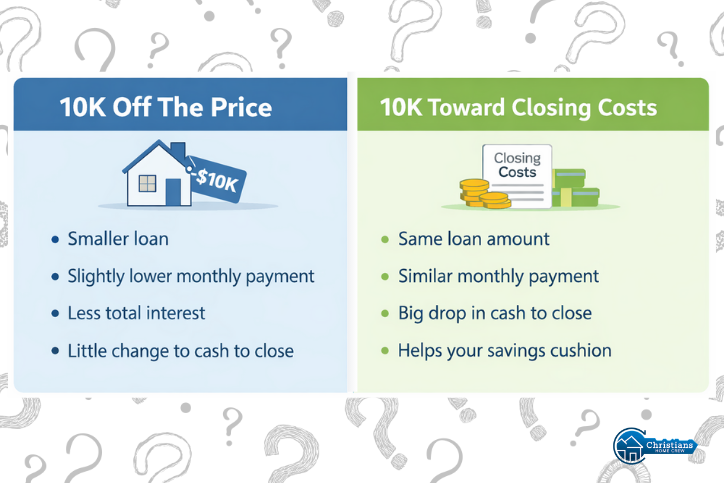
One helps your monthly budget and your long-term interest. The other helps your savings account and your stress level on closing day.
We can show you your own version of this comparison so you're not guessing.
Can the $10,000 be used to lower my interest rate instead?
Often, yes. Within program rules, your lender may be able to apply seller credits to buy down your interest rate rather than just cover fees. A lower rate can reduce your monthly payment more than a small price cut would — but not always. Buydown pricing shifts over time, so this has to be checked against your specific loan on the day you write the offer.
Here's roughly how it works:
- The seller gives you $10,000 in credits
- Your lender applies that money, within program rules, to reduce your interest rate
- In some situations, that lower rate drops your payment more than a $10,000 price reduction would
It doesn't always play out that way. The cost of a buydown and its effect on your rate change over time. Sometimes the price cut is the better move. Sometimes the buydown is.
The important part: you don't have to guess. Your lender can show you both choices on the same screen, for your specific loan, so you can see which one feels better for your life.
When does taking $10,000 off the price usually win?
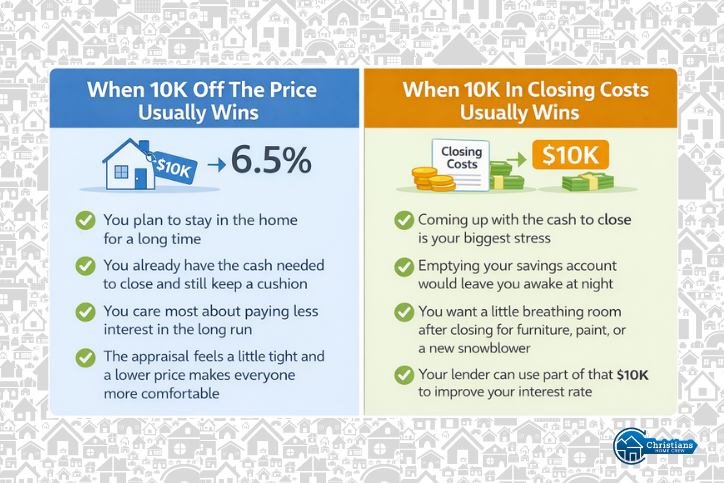
When you're staying a long time, you already have the cash to close with a cushion left over, and total interest matters more to you than closing-day cash. A lower price also helps when the appraisal feels tight, because it gives everyone more room.
You might lean toward a price reduction when:
- You plan to stay in the home for a long time
- You already have the cash needed to close and still keep a cushion
- You care most about paying less interest in the long run
- The appraisal feels a little tight and a lower price makes everyone more comfortable
In that situation, asking "what does this look like with $10,000 off the price?" is a smart conversation to have.
When does $10,000 in closing costs usually win?
When cash to close is the thing you're losing sleep over. If covering closing would drain your savings, or if your lender can turn part of that credit into a meaningfully better interest rate, the credit usually does more for you than the price cut would.
You might lean toward seller-paid costs when:
- Coming up with the cash to close is your biggest stress
- Emptying your savings account would leave you awake at night
- You want breathing room after closing for furniture, paint, or a new snowblower
- Your lender can use part of that $10,000 to improve your interest rate in a way that meaningfully reduces your payment
In that situation, asking "what happens if the seller helps with $10,000 toward my costs instead?" can open up options that feel a lot more comfortable.
What do sellers and appraisers see?
A seller often prefers credits, because they can still say they sold at a given price even though their net is the same. An appraiser looks at the contract price and recent sales, notes any seller-paid costs, and checks those credits fit within your loan program's limits. Your lender and I track those limits so the offer stays compliant.
Buyers aren't the only ones looking at your numbers.
From the seller's side
- A lower price can feel like giving up ground
- A full-price offer with credits lets them say "we sold for this price," even though their net is lower
From the appraiser's side
- They look at the contract price and recent sales
- They note any seller-paid costs in the contract
- They confirm the credits fit inside your loan program's guidelines
The good news is you don't have to manage that part. Your job is to be clear about what matters most to you, so your team can build the offer around it.
Worth a look: homeownership assistance programs in North Dakota and City of Fargo down payment assistance, if broader help with the cash side might apply to you.
How do I decide which one is right for me?
Three steps. Decide honestly whether cash to close or long-term cost is the bigger worry. Have your lender put both structures on one page for the specific house. Then pick the one that fits your life rather than a rule you read online.
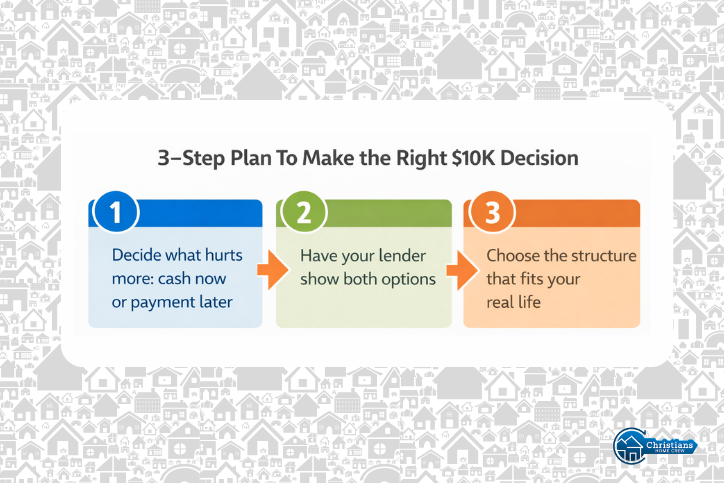
Decide what hurts more right now.
Is your bigger worry the cash to close, or the monthly payment and total interest over time?
Be honest about which one actually keeps you up at night. This is the step people skip, and it's the one that decides the answer.
Have your lender show you both options on one page.
Ask them to run, for the specific house you're considering: $10,000 off the price, and $10,000 in seller-paid costs — plus a rate buydown option if it makes sense.
Looking at your own numbers side by side is where it usually clicks.
Choose the structure that fits your life, not internet rules.
There's no single rule that works for every buyer, every market, and every home. The right answer is the one that solves your bigger problem.
Quick answers to common questions
These answers are general and for informational purposes only. Your situation may be different, so always confirm with your own lender.
No. The price cut saves more money over the long run, but the credit solves a problem that is happening this month. If closing would drain your savings, the long-run math doesn't help you much.
Compared to a price reduction, yes — slightly. Your loan amount stays higher because the price didn't change, so the payment stays roughly where it started rather than dropping. What you gain is cash in hand at closing.
Yes. Every loan program caps seller-paid costs, and the cap varies by program and by your down payment. Your lender will confirm the limit for your specific loan before we write the offer.
Not necessarily. Many sellers care about the headline sale price, and a full-price offer with credits can read better to them than a reduced-price offer that nets them the same amount. How it lands depends on the seller and the situation.
First home won at the 11th hour
Leif and Riley had already tried once and come up short. On this one they came within five days of losing it too — and still closed on time in West Fargo with nothing extra out of pocket. What you bring to the table on closing day is something you can plan for, not just absorb.
Eric D. Christians, REALTOR®
A Navy veteran and former home inspector who now helps buyers and sellers in West Fargo, Horace, Fargo, and Moorhead. When you work with Christians Home Crew, you work with Eric — from the first conversation through closing, not passed between team members.
Important note: This article is for general informational purposes only and is based on common loan structures and examples that may or may not apply to your situation. It is not legal, tax, or financial advice, and it is not a commitment to lend or a guarantee of any particular interest rate, payment amount, or loan approval.
Loan guidelines, interest rates, costs, and eligibility rules change frequently and can vary between lenders and programs in North Dakota, Minnesota, and elsewhere. Always talk with your own licensed lender, and when appropriate your tax professional or attorney, about your specific situation before making decisions about how to structure an offer or loan.
Run your own numbers before you write the offer
A no-pressure conversation for buyers, built around what actually determines your monthly cost and your comfort level with a property:
- Your priorities, budget, and real monthly cost
- Cash to close versus long-term interest, side by side
- Offer strategy, including price cuts, credits, and buydowns
- What to investigate further before you commit
Or call (701) 373-5155
Eric is a REALTOR®, not a lender. Loan structure, rates, and closing costs are confirmed by your own licensed lender.